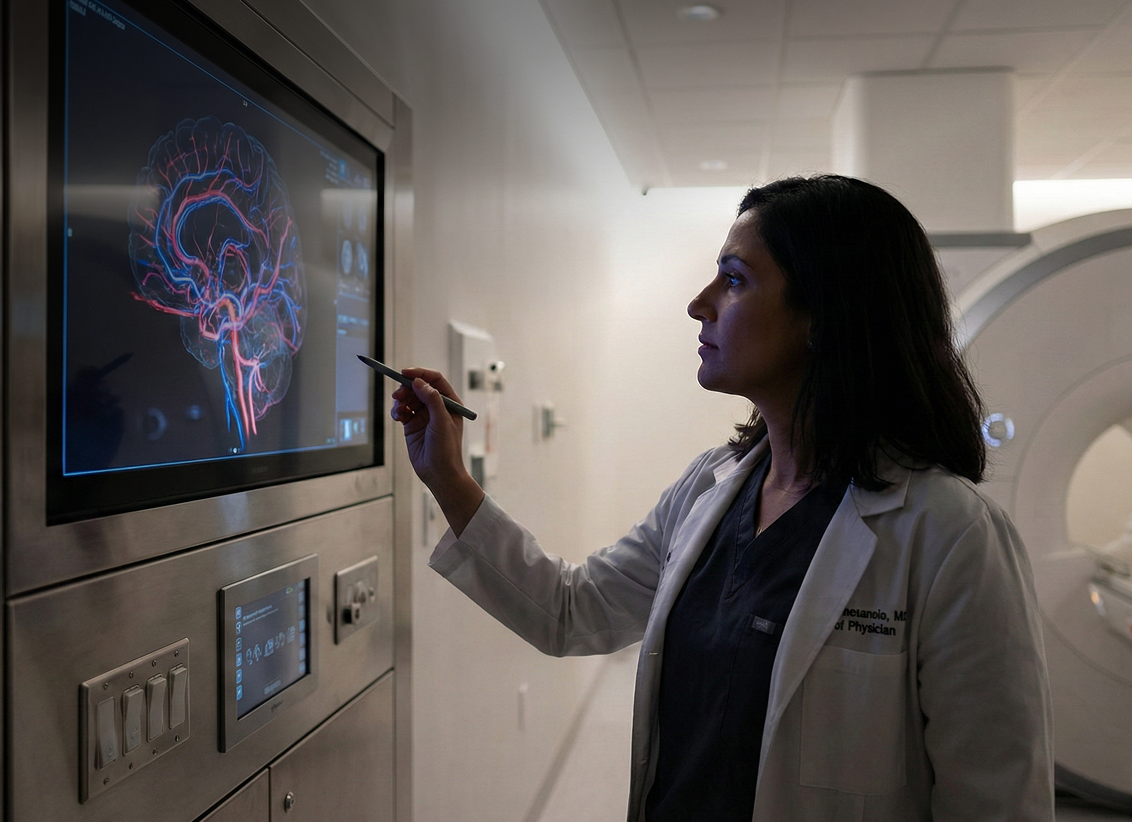
StrokeDX - Revolutionizing stroke diagnostics hero image
HealthcareOverview

StrokeDX

Revolutionizing stroke diagnostics

TL;DR

01

Built the software and analytics platform powering a portable, non-invasive handheld stroke diagnostic device, enabling real-time cerebral blood flow visualization at the point of care

02

Engineered the full communication system for hardware data acquisition and control, including USB protocol integration to support a new generation of the STEDI device

03

Designed a clinical-grade interface for emergency settings with real-time signal processing to detect and differentiate ischemic and hemorrhagic stroke signatures

The Challenge

Every minute of a stroke goes untreated, an estimated 1.9 million neurons die. Speed of diagnosis is not a clinical nicety; it is the primary determinant of whether a patient survives with their faculties intact. Yet the gold standard for stroke diagnosis, CT and MRI imaging, requires transporting the patient to a hospital, waiting for machine availability, and having a radiologist interpret results. In emergency settings outside major hospital centers, and especially in underserved regions, this chain of dependencies routinely costs patients the critical window for effective intervention.

StrokeDX was developing a fundamentally different approach: a portable, handheld, non-invasive cerebrovascular monitoring device that physicians and EMTs could use at the point of care. The hardware used non-radiating eddy current sensors to detect changes in cerebral blood flow, producing signal data that could differentiate ischemic strokes (blockages) from hemorrhagic strokes (bleeds), a critical distinction because the treatments for each are opposite.

The hardware innovation was only half the equation. Raw sensor data means nothing without software that can acquire it reliably, process it in real time, and present it in a form that a clinician under pressure can act on in seconds. StrokeDX needed a software partner who could build a clinical-grade platform, one capable of controlling the device, handling the data pipeline, running advanced signal analytics, and displaying results through an interface designed for high-stress emergency use.

The stakes for getting this right extended well beyond the engineering brief. Software failures in a diagnostic device are not bugs to be patched in the next release; they are potential patient safety events. Every architectural decision needed to account for clinical-grade data integrity, HIPAA compliance, and the eventual pathway to FDA regulatory clearance.

Key Results

01

Real-time cerebral blood flow visualization platform delivered for point-of-care emergency use

02

Signal analytics pipeline differentiating ischemic and hemorrhagic stroke signatures

03

Multi-generation hardware support: original device through USB-based next-gen STEDI integration

04

Clinical-grade data pipeline with HIPAA-compliant secure storage in SDX format

05

StrokeDX raised nearly $10M in funding; won MedTech Innovator Global Competition 2023

The Solution

01

Hardware Communication: Building the Device Interface Layer

The foundation of the platform is the communication system between the software and the STEDI diagnostic hardware. AE Studio built the full acquisition and control layer, establishing reliable data transfer from the device's sensors into the processing pipeline.

As StrokeDX developed a next-generation version of their device, AE extended this layer to support the new USB protocol, re-engineering the communication stack to accommodate the updated hardware interface, new data formats, and support for operating with a single device rather than the previous multi-device configuration. The USB integration work included building simulators to validate the full communication flow before physical hardware was available for testing.

02

Real-Time Signal Processing and Stroke Classification

The clinical value of the platform lives in its signal analytics. Raw sensor output from the device captures electromagnetic responses from cerebral tissue, data that must be processed, filtered, and interpreted to identify stroke signatures.

AE Studio built the advanced signal processing and analytics pipeline that transforms raw sensor readings into diagnostic information. The system detects patterns characteristic of ischemic events, where blood flow is obstructed, and distinguishes them from hemorrhagic signatures, where a vessel has ruptured. This differentiation is clinically critical: administering clot-busting medication to a hemorrhagic stroke patient can be fatal.

The analytics pipeline was designed for real-time operation, providing outputs that track temporal progression of the event and support immediate clinical decision-making rather than post-hoc review.

03

Clinical Interface Design for Emergency Settings

A diagnostic platform used in emergency conditions faces interface requirements fundamentally different from conventional software. Cognitive load is high, time is short, and the consequences of misreading a display are severe.

AE Studio designed the clinical interface with these constraints as primary requirements. The active scan page provides real-time sensor output plotting with clear visual differentiation between normal and anomalous readings. Controls for pausing and resuming scans are positioned for single-handed operation. A patient preparation page guides the clinical professional through the pre-scan checklist with visual cues for correct device positioning.

The calibration framework, a significant component of the second engagement, provides device status indicators and a calibration process interface that ensures the device is operating within validated parameters before a scan begins. An internal CLI was also built to support StrokeDX's technical team in device diagnostics and validation workflows.

04

Data Architecture for Clinical-Grade Integrity

Medical device software carries data obligations that standard application development does not. Every scan event, calibration record, and diagnostic output must be stored with integrity and traceability sufficient for clinical use and regulatory audit.

AE Studio built a secure data pipeline that writes scan results to the SDX file format StrokeDX uses for storing and sharing diagnostic records. The architecture was designed with HIPAA compliance as a foundation, with encryption in transit and at rest and access controls appropriate for protected health information.

The scalable data layer was built to support future integration pathways with hospital systems and medical imaging platforms, ensuring that the platform StrokeDX ships today does not create technical debt that blocks the integrations their commercial expansion will require.

05

Multi-Phase Engagement: From Proof of Concept to Production Device

AE Studio's work with StrokeDX spanned multiple phases, beginning with an initial feasibility and proof-of-concept study focused on classification and visualization of cranial blood flow data, and extending through successive phases as StrokeDX advanced toward clinical validation and commercial deployment.

The initial engagement established the core software architecture and data science foundation. Subsequent phases deepened the platform capabilities, adding more sophisticated analytics, refining the clinical interface, and ultimately integrating with the second-generation device hardware. This continuity meant AE Studio engineers carried deep institutional knowledge of the device's signal characteristics and clinical requirements across the full development arc.

06

Neuroscience Expertise Applied to Medical Device Software

StrokeDX's technology sits at the intersection of signal processing, neuroscience, and medical device regulation, a domain where general software development expertise is insufficient. AE Studio's prior work on brain-computer interface technology and other neurotechnology projects informed how the team approached the technical and regulatory dimensions of the StrokeDX platform.

The engineering team worked closely with StrokeDX's CTO Brian Nguyen, a Caltech-trained electrical engineer specializing in signal processing and medical imaging, to ensure that the software implementation faithfully reflected the underlying physics of the eddy current sensing technology and met the standards required for a device on a clinical regulatory pathway.

Results

Key Metrics

Real-time cerebral blood flow visualization platform delivered for point-of-care emergency use

Signal analytics pipeline differentiating ischemic and hemorrhagic stroke signatures

Multi-generation hardware support: original device through USB-based next-gen STEDI integration

Clinical-grade data pipeline with HIPAA-compliant secure storage in SDX format

StrokeDX raised nearly $10M in funding; won MedTech Innovator Global Competition 2023

The Full Story

AE Studio helped StrokeDX build the software platform powering a portable, non-invasive stroke diagnostic device designed to bring point-of-care cerebrovascular monitoring to emergency settings. The platform enables real-time visualization of cerebral blood flow patterns, advanced signal analytics for ischemia and hemorrhage differentiation, and a clinical-grade interface designed for use under emergency conditions.

The multi-phase engagement tracked StrokeDX through successive generations of their hardware, from initial proof-of-concept through integration with a next-generation device featuring a new USB protocol and updated data architecture. Each phase extended the platform's clinical capabilities while maintaining the data integrity and security standards required for a medical device on a regulatory pathway.

StrokeDX has since raised nearly $10 million in funding, including an oversubscribed $5 million Seed Prime round in 2024. The company won the MedTech Innovator Global Competition in 2023 and received the Vision Award at the WSGR Medical Device & Digital Health Conference. Co-founders Alex Ballatori and Shane Shahrestani were named to Forbes' 30 Under 30 for Science in 2025. The platform AE Studio helped build is central to StrokeDX's clinical validation and commercial expansion efforts.

Conclusion

Stroke is a time-critical emergency where the difference between arriving at diagnosis in ten minutes versus two hours is the difference between a patient walking out of the hospital and permanent disability. StrokeDX's vision of a portable, point-of-care diagnostic device addresses one of the most consequential bottlenecks in emergency medicine.

AE Studio's contribution was the software platform that makes the hardware clinically usable: the data acquisition layer that talks to the device, the signal analytics that interpret what the sensors detect, and the clinical interface that puts actionable information in front of the physician in time to matter. The platform is built for the regulatory pathway StrokeDX is on, the commercial expansion they are executing, and the hospital integrations that will follow.

This project represents AE Studio's neurotechnology practice at its most consequential, engineering applied to a domain where the measure of success is not uptime or conversion rate, but lives.

Key Insights

1

Speed of diagnosis is the clinical outcome. Every architectural decision in a stroke diagnostic platform, from data acquisition latency to interface cognitive load, traces back to the seconds it takes a clinician to act. Building for speed is building for patient outcomes.

2

Signal differentiation is the hard problem. Detecting a stroke is not the same as classifying it. The analytics work to distinguish ischemic from hemorrhagic signatures required deep collaboration between software engineers and domain experts in signal processing and neuroscience.

3

Medical device software requires regulatory foresight from day one. Data integrity, HIPAA compliance, and audit traceability are not features added before submission; they are architectural properties that must be built into the foundation or retrofitted at enormous cost.

4

Multi-phase partnerships compound in value. AE Studio's continuity across multiple device generations meant the engineering team carried signal-level knowledge of the hardware's behavior that would have taken a new team months to develop. Institutional knowledge is a technical asset.

5

Interface design for high-stress clinical environments demands different constraints. Controls must be operable under cognitive load, displays must communicate urgency hierarchy at a glance, and calibration workflows must be foolproof, standards that standard product UX frameworks do not address.

Frequently Asked Questions

STEDI is StrokeDX's portable, handheld cerebrovascular monitoring device. It uses non-invasive, non-radiating eddy current sensors to detect changes in cerebral blood flow, the physical signal that indicates whether a stroke is occurring and what type. The software platform AE Studio built handles everything from controlling the device and acquiring its sensor data, to processing and analyzing that data in real time, to displaying the results through a clinical interface designed for emergency use. Without the software layer, the sensor data is uninterpretable.
Ischemic strokes are caused by blood clots blocking flow to the brain. Hemorrhagic strokes are caused by ruptured blood vessels bleeding into brain tissue. The primary treatment for ischemic strokes, clot-dissolving medication, can be fatal if administered to a hemorrhagic stroke patient, because it would accelerate the bleed. Correctly classifying stroke type at the point of care is therefore not just clinically useful but potentially the difference between effective treatment and a fatal error. The signal analytics AE Studio built were specifically designed to make this differentiation reliably and in real time.
CT and MRI are the gold standard for stroke imaging but require hospital infrastructure, patient transport, machine availability, and radiologist interpretation, a chain of dependencies that takes time the patient may not have. StrokeDX's device is designed for point-of-care use: it can be deployed by EMTs in the field, in emergency rooms without dedicated neuroimaging suites, and in healthcare settings in underserved regions where CT and MRI are not available. The goal is not to replace hospital imaging but to enable faster initial triage and diagnosis before or instead of transport.
Every scan event, calibration record, and diagnostic output is stored in StrokeDX's SDX file format through a secure data pipeline with encryption in transit and at rest. Access controls are structured around protected health information requirements. The architecture was also designed with future integration into hospital systems in mind, ensuring that the compliance foundations built now support the data exchange requirements of commercial deployment rather than requiring a rebuild when StrokeDX reaches those partnerships.
AE Studio has an active neurotechnology practice spanning brain-computer interfaces, medical device software, and neuroscience-adjacent applications. Prior work includes supporting development of FDA-approved implantable BCI systems. This domain expertise informed how the team approached StrokeDX's project, particularly the signal processing, regulatory foresight, and clinical interface requirements that differentiate medical device software from conventional product development. AE Studio's neuroscience initiatives page has more information on this body of work.
OverviewHealthcareadvanced8 min readMedical DeviceNeurotechnologyStroke DiagnosticsSignal ProcessingReal-Time AnalyticsHealthcareClinical InterfaceHIPAAPoint-of-Care

Published: Feb 2025 ยท Last updated: Feb 2026

Ready to build something amazing?

Let's discuss how we can help transform your ideas into reality.