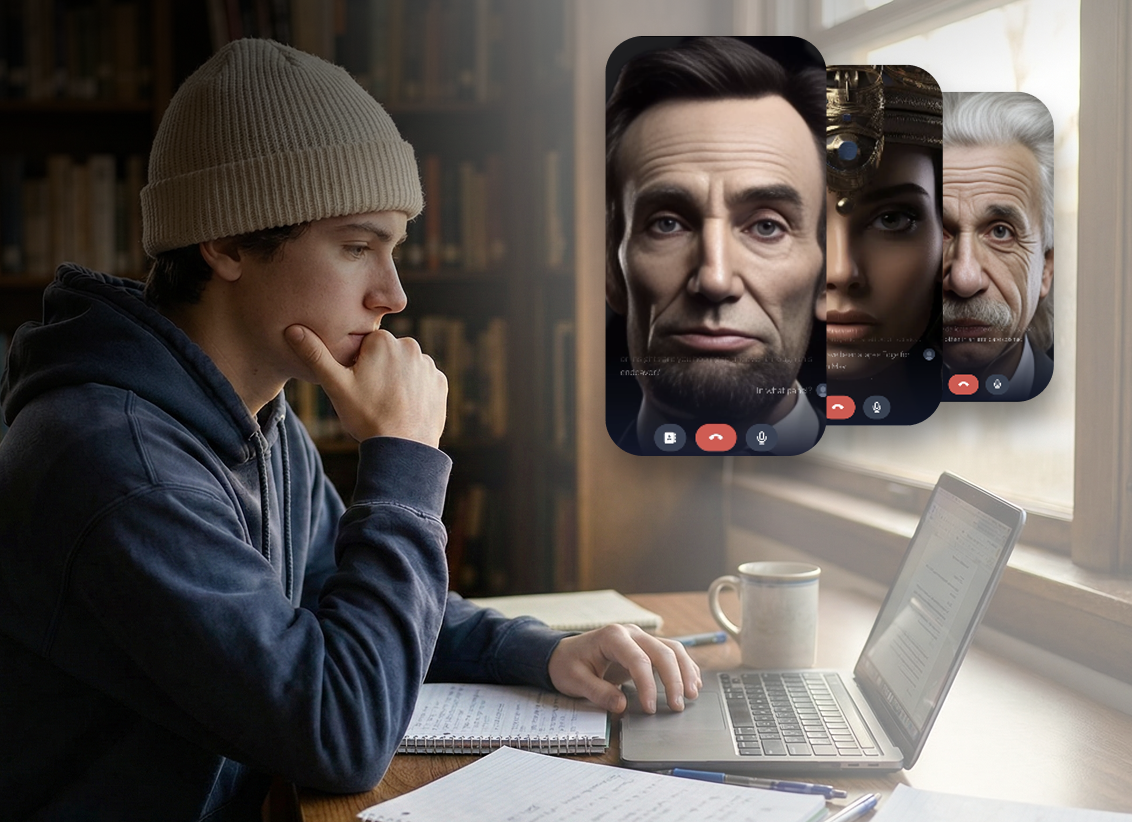
Alpha School's AI Avatar Tutors - Real-Time Conversational AI Tutors That Outperform HeyGen hero image
Education TechnologyOverview

Alpha School's AI Avatar Tutors

Real-Time Conversational AI Tutors That Outperform HeyGen

TL;DR

01

Built a fully proprietary real-time conversational AI avatar system from scratch, outperforming HeyGen's capabilities at the time of development

02

Engineered a custom phoneme-to-viseme lip-sync pipeline on Azure Cognitive Services, vendor-agnostic, audio-in to facial-expression-out, enabling lifelike speech animation for cartoon avatars

03

Deployed across multiple Alpha School products including AskElle and DreamLauncher, with a live interactive demo at personas.alpha.school featuring selectable historical figure personas

The Challenge

Alpha School runs on a radical premise: students spend just two hours per day on AI-driven core instruction, then own the rest of their time for passion projects, physical activity, and self-directed learning. To make that model work, the AI doing the teaching has to be extraordinary. It can't feel like a chatbot reading from a script. It has to feel like a tutor who knows the student, responds naturally, and keeps them engaged.

Existing avatar solutions weren't up to the task. HeyGen and similar platforms offered pre-rendered video loops with limited interactivity. They couldn't hold a real conversation, adapt to a student's current emotional state, or respond dynamically to what was happening in a lesson. For Alpha's vision, AI tutors that millions of students would interact with daily, these tools were a dead end.

Alpha needed a fully custom, real-time conversational avatar system. One that could be integrated into any product across their ecosystem, support thousands of simultaneous student sessions, and deliver the kind of lifelike, responsive interaction that makes students forget they're talking to software.

The technical bar was high. Real-time lip-sync for cartoon avatars is a hard problem. Natural-sounding, emotionally expressive AI voice is a hard problem. Building all of it into a scalable, multi-product platform, while shipping fast enough to keep pace with Alpha's weekly release cadence, made it harder still.

Key Results

01

Outperformed HeyGen on real-time interactivity at time of build

02

Supports thousands of simultaneous avatar sessions

03

Multi-language and multi-resolution support across all devices

04

Live across AskElle and DreamLauncher with full educational context integration

05

Vendor-agnostic lip-sync pipeline enabling seamless TTS provider migration

The Solution

01

A Proprietary Avatar Engine Built From Scratch

Rather than licensing an off-the-shelf avatar platform, AE Studio built a full end-to-end proprietary system designed specifically for Alpha's needs. This gave Alpha complete control over the technology, no vendor dependencies, no feature ceilings, no licensing constraints as they scaled.

The result is a cartoon-style avatar engine capable of real-time conversational interaction. Students can ask questions mid-lesson, receive immediate responses, and experience dialogue that adapts to what they've said and what the system knows about them. The avatars aren't playing back pre-recorded segments, they're generating responses and animating in real time.

02

Custom Lip-Sync: Phoneme-to-Viseme Pipeline

The most technically demanding piece of the system is lip-sync. Making a cartoon avatar's mouth match spoken audio in real time, accurately, without lag, across a wide range of TTS voices, requires a custom pipeline.

We built a phoneme-to-viseme engine on top of Microsoft Azure Cognitive Services. The pipeline takes audio as input and outputs the precise facial muscle states (blendshapes and frame positions) needed to animate the avatar's mouth and face accurately for each spoken sound.

The architecture is vendor-agnostic by design. The lip-sync layer doesn't care what TTS engine is generating the audio. This meant we could later integrate ElevenLabs for higher-quality voice output, with emotion tags, pacing control, style exaggeration, and custom voice cloning, without rebuilding the animation layer.

03

Expressive Voice: From Azure TTS to ElevenLabs

Early versions of the system used Azure Cognitive Services for text-to-speech. This worked, but the voices were recognizably synthetic, acceptable, not compelling.

We built and validated a custom voice POC using ElevenLabs, which offers significantly more expressive output: emotion markers embedded in text, variable pacing, style intensity controls, and the ability to clone specific voices. For an educational context where student engagement depends on how the tutor sounds, this was a meaningful upgrade.

The voice cloning capability opens a particularly interesting design space. Alpha can create avatar tutors with distinct, consistent personalities, voices that feel like a specific character rather than a generic AI.

04

Multi-Persona Architecture: One Base, Infinite Characters

The avatar system is architected around a single base model that can be skinned into any number of distinct personas. This is visible in the live demo at personas.alpha.school, visitors can switch between historical figures like Abraham Lincoln, each running from the same underlying avatar engine but presenting differently.

For Alpha, this means the same technical infrastructure supports tutors across subjects, grade levels, and product contexts. A math coach, a reading mentor, and a career counselor can all run on the same platform with distinct visual identities, voice styles, and instructional contexts.

05

Seamless Integration Across Alpha's Product Ecosystem

The avatar system was designed as an embedded component, not a standalone product. It plugs into Alpha's existing courseware and lesson flows, gaining access to each student's learning context, their current unit, recent performance, skill gaps, and goals.

This integration is live in AskElle, Alpha's AI-powered question-and-answer companion, and DreamLauncher, Alpha's platform for helping students identify and pursue their passions. In both contexts, the avatar doesn't just respond to isolated questions, it incorporates the student's broader educational profile into every interaction.

06

Built to Scale: Thousands of Simultaneous Sessions

Alpha's ambition is to educate a billion children. The avatar infrastructure had to be architected with that scale in mind from day one.

The system supports thousands of simultaneous avatar sessions without degradation in response quality or latency. Multi-language support ensures accessibility across geographies. Multi-resolution rendering ensures consistent visual quality across the wide range of devices students use.

Advanced analytics run in parallel with every session, tracking interaction patterns, student response behaviors, and contextual signals that feed back into Alpha's broader personalization engine.

07

Outperforming HeyGen: The Benchmark That Mattered

When AE Studio began building the Alpha avatar system, HeyGen was the most visible avatar platform on the market. We benchmarked against it directly. At the time of development, HeyGen couldn't match what we built, particularly on real-time interactivity and the depth of conversational integration with educational context.

The gap wasn't a minor performance difference. HeyGen's architecture at the time was oriented around pre-rendered video, not live generative conversation. Alpha needed something fundamentally different, and that's what we delivered.

Results

Key Metrics

Outperformed HeyGen on real-time interactivity at time of build

Supports thousands of simultaneous avatar sessions

Multi-language and multi-resolution support across all devices

Live across AskElle and DreamLauncher with full educational context integration

Vendor-agnostic lip-sync pipeline enabling seamless TTS provider migration

The Full Story

AE Studio delivered a fully proprietary, real-time conversational AI avatar system that is now live across multiple Alpha School products. The system powers student interactions in AskElle and DreamLauncher, with a publicly accessible demo at personas.alpha.school demonstrating the full range of what the platform can do.

The avatar technology outperformed HeyGen, the leading commercial alternative at the time, on real-time interactivity, conversational depth, and integration with educational context. This wasn't a marginal improvement: the architectural difference between pre-rendered avatar video and true real-time generative conversation is fundamental.

The phoneme-to-viseme lip-sync pipeline delivers accurate, low-latency facial animation that holds up across a wide range of voices and speaking styles. The vendor-agnostic design allowed AE to migrate from Azure TTS to ElevenLabs for higher-quality voice output without rebuilding the animation layer, a decision that significantly improved the expressiveness and engagement quality of the tutoring experience.

The multi-persona architecture means Alpha can expand their tutor roster indefinitely without additional infrastructure work. The same base system that runs Abraham Lincoln on the demo site runs every subject-matter tutor across their product line.

The platform scales to thousands of simultaneous sessions with multi-language and multi-resolution support, infrastructure that matches Alpha's goal of reaching a billion students globally.

Conclusion

Alpha School's avatar tutors aren't a feature, they're the delivery mechanism for a new model of education. The goal is for every student to have a tutor that knows them, responds to them in real time, and keeps them engaged across two hours of daily intensive instruction.

Building that required building something that didn't exist. The proprietary avatar engine AE Studio delivered, with its custom lip-sync pipeline, expressive voice integration, multi-persona architecture, and deep product integration, is now the foundation Alpha's AI-education OS runs on. As Alpha pursues its ambition to educate a billion children, the avatar infrastructure scales with them.

Key Insights

1

Building proprietary rather than licensing gives AI-first companies the control they need to scale. Off-the-shelf avatar platforms impose feature ceilings that compound as the product grows.

2

Lip-sync is a harder problem than it looks. A phoneme-to-viseme pipeline that's vendor-agnostic from the start pays dividends when you need to swap TTS providers without rebuilding animation.

3

Voice quality is a meaningful lever for student engagement. Moving from generic TTS to emotionally expressive, stylistically controllable voice output changes how students experience the tutor.

4

A multi-persona architecture is the right abstraction. One base model that skins into infinite characters is far more scalable than building individual avatar systems per use case.

5

Real-time conversational avatars and pre-rendered video loops are fundamentally different products. For educational contexts that require adaptive, contextual interaction, only the former works.

6

Analytics integration from day one creates compounding value. Every session generates data that improves personalization, but only if the infrastructure captures it from the start.

Frequently Asked Questions

The system combines a real-time conversational AI layer with a custom animation engine. When a student speaks or submits input, the AI generates a response, passes the text to a TTS engine (currently ElevenLabs), and routes the resulting audio through a phoneme-to-viseme pipeline that translates each spoken sound into precise facial muscle positions for the cartoon avatar. This all happens in under a second, producing the appearance of natural, responsive conversation. The pipeline is vendor-agnostic, the lip-sync layer is decoupled from the TTS engine, which allows the underlying voice technology to be upgraded without rebuilding the animation system.
HeyGen and similar platforms are designed around pre-rendered video, not real-time generative conversation. For Alpha's use case, tutors that adapt dynamically to each student's current lesson, performance history, and conversational context, pre-rendered video is a dead end. You can't pre-render every possible thing a student might say. Building proprietary also gave Alpha full control over the technology stack. No licensing dependencies, no feature constraints imposed by a third-party roadmap, and no ceiling on how the system can evolve as Alpha's product grows.
The avatar system is integrated into AskElle, Alpha's AI-powered student Q&A companion, and DreamLauncher, Alpha's passion and career exploration platform. A publicly accessible demo is available at personas.alpha.school, where users can interact with multiple historical figure personas, Abraham Lincoln and others, all running on the same underlying avatar engine.
Because the avatar is embedded directly into Alpha's product ecosystem rather than running as a standalone tool, it has access to each student's educational profile, their current unit, recent assessment results, skill gaps, learning pace, and goals. This context is passed into every conversational interaction, allowing the avatar to reference what the student has been working on, adjust the difficulty and framing of explanations, and provide feedback that reflects actual performance rather than generic responses.
Yes. The platform includes multi-language support to serve Alpha's global student population, and multi-resolution rendering to maintain visual quality across the range of devices students use, from tablets to lower-powered hardware in under-resourced schools. The architecture was designed for global scale from the start, supporting thousands of simultaneous sessions without degradation in latency or response quality.
OverviewEducation Technologyadvanced7 min readAI AvatarsConversational AIEdTechReal-Time AIText-to-SpeechLip SyncPersonalized LearningAlpha SchoolAI Tutoring

Published: Jan 2026 ยท Last updated: Feb 2026

Ready to build something amazing?

Let's discuss how we can help transform your ideas into reality.

Real-Time AI Avatar Tutors for Alpha School | AE Studio